Sunday, January 20, 2008

The Godfather


United States, 1972
Running Length: 2:51
MPAA Classification: R (Violence, mature themes, language, brief nudity)
Theatrical Aspect Ratio: 1.85:1
Cast: Marlon Brando, Al Pacino, James Caan, Robert Duvall, Diane Keaton, Talia Shire, Al Lettieri, Sterling Hayden, John Cazale
Director: Francis Ford Coppola
Producer: Albert S. Ruddy
Screenplay: Francis Ford Coppola and Mario Puzo based on the novel by Mario Puzo
Cinematography: Gordon Willis
Music: Nino Rota
U.S. Distributor: Paramount Pictures

Rarely can it be said that a film has defined a genre, but never is that more true than in the case of The Godfather. Since the release of the 1972 epic (which garnered ten Academy Award nominations and was named Best Picture), all "gangster movies" have been judged by the standards of this one (unfair as the comparison may be). If a film is about Jewish mobsters, it's a "Jewish Godfather"; if it's about the Chinese underworld, it's an "Oriental Godfather"; if it takes place in contemporary times, it's a "modern day Godfather."

If The Godfather was only about gun-toting Mafia types, it would never have garnered as many accolades. The characteristic that sets this film apart from so many of its predecessors and successors is its ability to weave the often-disparate layers of story into a cohesive whole. Any of the individual issues explored by The Godfather are strong enough to form the foundation of a movie. Here, however, bolstered by so many complimentary themes, each is given added resonance. The picture is a series of mini-climaxes, all building to the devastating, definitive conclusion.

Rarely does a film tell as many diverse-yet-interconnected stories. Strong performances, solid directing, and a tightly-plotted script all contribute to The Godfather's success. This motion picture was not slapped together to satiate the appetite of the masses; it was carefully and painstakingly crafted. Every major character - and more than a few minor ones - is molded into a distinct, complex individual. Stereotypes did not influence Coppola's film, although certain ones were formed as a result of it.

The film opens in the study of Don Vito Corleone (Marlon Brando), the Godfather, who is holding court. It is the wedding of his daughter Connie (Talia Shire), and no Sicilian can refuse a request on that day. So the supplicants come, each wanting something different - revenge, a husband for their daughter, a part in a movie.

The family has gathered for the event. Michael (Al Pacino), Don Vito's youngest son and a second world war hero, is back home in the company of a new girlfriend (Diane Keaton). The two older boys, Sonny (James Caan) and Fredo (John Cazale), are there as well, along with their "adopted" brother, Tom Hagen (Robert Duvall), the don's right-hand man.

With the end of the war, the times are changing, and as much as Don Vito seems in control at the wedding, his power is beginning to erode. By the standards of some, his views on the importance of family, loyalty, and respect are antiquated. Even his heir apparent, Sonny, disagrees with his refusal to get into the drug business. Gambling and alcohol are forces of the past and present; narcotics are the future. But Don Vito will not compromise, even when a powerful drug supplier named Sollozzo (Al Lettieri) arrives with promises of high profits for those who back him.

Don Vito's refusal to do business with Sollozzo strikes the first sparks of a war that will last for years and cost many lives. Each of the five major mob families in New York will be gouged by the bloodshed, and a new order will emerge. Betrayals will take place, and the Corleone family will be shaken to its roots by treachery from both within and without.

The Corleone with the most screen time is Michael (it's therefore odd that Al Pacino received a Best Supporting Actor nomination), and his tale, because of its scope and breadth, is marginally dominant. His transformation from "innocent" bystander to central manipulator is the stuff of a Shakespearean tragedy. By the end, this man who claimed to be different from the rest of his family has become more ruthless than Don Vito ever was.

Despite the likes of Serpico, Dog Day Afternoon, Scarface, ...And Justice for All, and Scent of a Woman on his resume, Pacino is best remembered for the role he created in The Godfather (and subsequently reprised in two sequels). While this is not his most demonstrative performance - indeed, he is exceptionally restrained - the quality of the script makes Michael Corleone notable.

Next to Humphrey Bogart's Rick from Casablanca, Oscar winner Marlon Brando's Don Vito may be the most imitated character in screen history. The line "I'm gonna make him an offer he can't refuse" has attained legendary status, as has the entire performance. With his raspy voice, deliberate movements, and penetrating stare, Brando has created a personae that will be recalled for as long as motion pictures exist.

Don Vito is a most complicated gangster. In his own words, he is not a killer, and he never mixes business with personal matters. He puts family first ("A man who doesn't spend time with his family can never be a real man") and despises displays of weakness. He understands the burden of power, and his wordless sympathy for Michael when he is forced to assume the "throne", is one of The Godfather's most revealing moments (about both father and son).

The Godfather had three Best Supporting Actor nominees, all well-deserved. The first was Pacino (who probably should have been nominated alongside Brando in the Best Actor category). The other two were James Caan and Robert Duvall. In a way, it's surprising that Duvall wasn't passed over. His presence in The Godfather isn't flashy or attention-arresting. Like his character of Tom Hagen, he is steady, reliable, and stays in the background. Not so for Caan's Sonny, whose demonstrative and volatile personality can't be overlooked.

Family responsibility. A father's legacy. The need to earn respect. The corrupting influence of power. These are some of the ingredients combined in Francis Ford Coppola's cinematic blender. They are themes which have intrigued the greatest authors of every medium through the centuries.

Although the issues presented in The Godfather are universal in scope, the characters and setting are decidedly ethnic. Even to this day, there is an odd romanticism associated with New York's Italian crime families. The word "Mafia" conjures up images of the sinister and mysterious - scenes of the sort where Luca Brasi meets his fate. Francis Ford Coppola has tapped into this fascination and woven it as yet another element of the many that make his motion picture a compelling experience.

We come to The Godfather like Kay Adams - outsiders uncertain in our expectations - but it doesn't take long for us to be captivated by this intricate, violent world. The film can be viewed on many levels, with equal satisfaction awaiting those who just want a good story, and those who demand much more. The Godfather is long, yes - but it is one-hundred seventy minutes well-spent. When the closing credits roll, only a portion of the story has been told. Yet that last haunting image (Kay's shock of recognition), coupled with Nino Rota's mournful score, leaves a crater-like impression that The Godfather Part II only deepens

Movie Review : Wild Hogs

Four middle-aged men, three stuck in dysfunctional relationships and one unable to even talk to a woman, get their motors running and head out on their Harleys in Wild Hogs, a comedy from Van Wilder director Walt Becker. Wild Hogs takes the 'let's throw in every goofy set-up we can and see if something works' approach to filmmaking and actually manages a few decent comedic moments - almost in spite of itself.


Pros

Travolta, Allen, Macy and Lawrence sell the friendship and fit together well
Enough slapstick comedy to keep it chugging along
It gets a few Brownie points for trying to include a little heart along with the laughs


Cons

Surprisingly homophobic for a studio film in this day and age
The nerdy computer guy can't use his own laptop - yeah, right!
Description
Stars John Travolta, William H Macy, Tim Allen, Martin Lawrence, Ray Liotta, and Marisa Tomei
The actors had varying degrees of experience riding motorcycles before the film, with Travolta easily the best of the group
Rated PG-13 for crude and sexual content, and some violence
Theatrical Release Date: March 2, 2007
Guide Review - "Wild Hogs" Movie Review


The Story

John Travolta, William H Macy, Tim Allen and Martin Lawrence play buddies who feel the need to escape from their 9-to-5 lives and decide the best way to recapture some of their lost youth is to take off on their Harleys. The foursome includes Doug (Allen), a dentist with identity issues; Bobby (Martin), a frustrated writer forced by his domineering wife to return to the world of plumbing; Dudley (Macy), a 40-year-old virgin who can't speak to a woman if his life depends on it; and Woody, the 'leader' of the pack who instigates the roadtrip. Woody's so-called charmed life with a swimsuit model wife and successful business is all a big front, and he needs to get away with his best buds to put some distance between himself and his troubles.

Off they go and, of course, absolutely nothing turns out as they planned. Their tents burn down and they encounter a motorcycle cop who believes the men are lovers and wants to join in on the fun. Things get really hairy when they run afoul of a group of real bikers who don't like couch potato posers who think black leather jackets and a cool logo patch are all it takes to be bikers.

To Sum It Up

Although they sound like an unlikely group of actors to play friends, Allen, Travolta, Macy and Lawrence are absolutely convincing. The acting's not the problem with Wild Hogs. The film's downfall is the time spent building the backstories and showing the families of the foursome. Wild Hogs might have been much more enjoyable if it left out their families completely and just concentrated on the buddy humor, freeing up time for more slapstick comedy - the part of the film that works the best.


Wild Hogs is forgettable, but fun in parts. From bull-slapping to naked waterhole antics, Wild Hogs tries its hardest to rise above road trip movie clichés and just barely makes it.

GRADE: C+

Friday, January 11, 2008

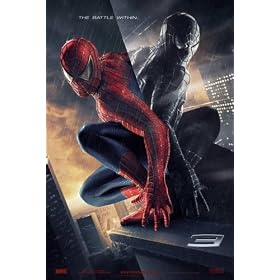
Movie Review: Spider-Man 3


Sam Raimi and his co-writers Ivan Raimi and Alvin Sargent apparently adopted the more is better approach with what could be Raimi’s final film of the Spider-Man franchise. The desire to include more villains, more action, and more romance gave birth to a Spider-Man 3 bloated with unfulfilling storylines, underdeveloped characters, and a film that’s literally all over the place. It's sort of fun, but not the Spider-Man film we've come to expect from Raimi and company.

The Many Stories
Mary Jane (Kirsten Dunst) gets her name in lights and Peter Parker (Tobey Maguire) is right there supporting his woman, clapping and singing and preparing himself to pop the question. But there’s trouble brewing in their relationship as MJ gets dumped from her Broadway show and wants someone to listen to her whine, and Peter’s not fulfilling his duties as a sounding board. Instead he’s busy soaking in all the adoration being lavished on Spider-Man by the citizens of New York.

Meanwhile Harry (James Franco) still wants revenge for his father’s death at Spider-Man’s hands. After a sweet chase scene in and out of the streets and alleyways, the New Goblin develops a medical condition and for a while everything is hunky-dory. But things don’t stay that way…

While Peter’s dealing with Harry and MJ, Flint Marko escapes from prison bent on helping his sick daughter. In a strange twist of events, he’s chased into a particle physics chamber and becomes Sandman. Then to make things even more complicated for poor Peter, a new photographer named Eddie Brock (Topher Grace) shows up at The Daily Bugle and wants Peter’s job – something that doesn’t sit well with the normally even-tempered Parker. And speaking of Parker’s easygoing personality, a black goopy thing crawls out of a meteor which just happens to land right next to where Peter and MJ are making out. After hitching a ride on Peter’s scooter, the gooey substance attaches itself to Peter, turning Spider-Man’s red and blue suit black. It also turns Mr Average Geeky Guy into an arrogant, self-centered creep.

So, let’s recap: We’ve got Peter’s romance with MJ on the rocks, Eddie trying to hone in on Peter’s job, Sandman causing chaos and robbing banks, Harry wanting Peter dead for killing his dad, and an outer space hitchhiker screwing with Peter/Spider-Man’s personality. What’s missing? A love triangle introduced in the shapely form of Gwen Stacy (Bryce Dallas Howard). And, of course, Venom - the villain Spidey fans love and who doesn't get nearly enough screen time in Spider-Man 3.
The Good

The action sequences are, for the most part, spectacular. The fight scenes live up to the standards set by the previous Spider-Man films, yet it’s when Raimi allows Maguire as Parker a few quiet moments to reflect on life that the film really comes close to matching Spider-Man and Spider-Man 2 in tone. Maguire has grown into the part and Spider-Man 3, while not the best of the lot, features his best performance of the series. The same can be said of James Franco who redeems himself after a series of bad film choices (Flyboys, Annapolis) by making Harry into a multi-layered character such as we haven’t seen in the previous two outings.


Bruce Campbell steals the film as a French restaurateur who tries to help Peter pop the question. Topher Grace and Thomas Haden Church are also terrific, with the totally buffed up Haden Church selling the part of a desperate dad without the benefit of much dialogue. Grace is given a lot to say and as the film’s comic relief, he seems right at home spewing one-liners and lightening the mood.

The Bad


Spider-Man 2’s Doc Ock set the bar high for villains and neither Venom nor Sandman come close to achieving what Alfred Molina pulled off. Venom’s underutilized and Sandman’s just not an interesting foe. Sure, he’s big and sandy and the effects look awesome, but either I missed something or the rules on how to deal with him change as the film plays out which is very frustrating for someone not familiar with the comic books.
Bryce Dallas Howard is pretty however her Gwen Stacy got the short end of the stick when it came to character development. But at least there is a real spark between Howard and Maguire, which can’t be said of Dunst and Maguire onscreen. The total lack of chemistry this time out is startlingly apparent, and Dunst’s MJ isn’t even fun to watch (or listen to). MJ’s too needy in Spider-Man 3 and it’s a real downer when she’s onscreen.

Some Spidey fans are going to love it when Peter Parker breaks out in his best John Travolta/Saturday Night Fever impersonation, but seeing the beloved character disco dance his way down the streets was unnerving and completely silly. And when Peter hits the dance floor to strut his stuff, Raimi pushed things too far. It’s corny and out of place, and a really bizarre way of showing the character’s darker side. Actually, other than a scene with Grace, the whole depiction of Parker’s inner battle is bland. Most of it’s done by having Maguire part his hair on the other side and let a few wisps hang down in his face, while flirting with various women in a totally harmless manner. The 'evil' turn Parker takes doesn't get dark enough.


Another major disappointment is the ending of Spider-Man 3. Lord of the Rings: The Return of the King just barely got away with multiple endings, but Spider-Man 3 doesn’t pull it off. There’s a terrific - and appropriate - ending, and then there’s two more tacked onto that. Enough already!
The Bottom Line

Spider-Man 2 is one of my all-time favorite comic book-inspired films. Spider-Man 3 doesn’t even rank in the top 10. The first Spider-Man did a fantastic job of telling the origin story. I’ve never picked up a comic book and with Spider-Man I understood the hows and whys of the webslinger. Spider-Man was fun. With Spider-Man 2 Raimi allowed us inside Peter Parker’s head, delivering an emotionally gripping story along with a few incredible action scenes. But Spider-Man 3 is crammed full of mini-plots, most of which aren't allowed to play out completely. Even 140 minutes isn’t long enough to do justice to three villains, a love triangle, and a Peter Parker who takes a walk on the wild side.

Spider-Man 3 is critic-proof and will no doubt make a ton of cash, but it doesn’t deliver enough bang for the buck. The film actually leaves you hoping Raimi and Maguire will return for one more shot at making the definitive Spider-Man movie, because 3 isn’t it.

Grade: C+

Spider-Man 3 was directed by Sam Raimi and is rated PG-13 for sequences of intense action violence.

Wednesday, January 2, 2008

THE BOURNE ULTIMATUM


Jaw clenched, brow knotted, body tight as a secret, Matt Damon hurtles through “The Bourne Ultimatum” like a missile. He’s a man on a mission, our Matt, and so too is his character, Jason Bourne, the near-mystically enhanced superspy who, after losing his memory and all sense of self, has come to realize that he has also lost part of his soul. For Bourne, who rises and rises again in this fantastically kinetic, propulsive film, resurrection is the name of the game, just as it is for franchises. This is the passion of Jason Bourne, with a bullet.

Their sights set far beyond the usual genre coordinates, the three Bourne movies drill into your psyche as well as into your body. They’re unusually smart works of industrial entertainment, with action choreography that’s as well considered as the direction. Doug Liman held the reins on the first movie, with Paul Greengrass taking over for the second and third installments. And while the two men take different approaches to similar material (the more formally bold Mr. Greengrass shatters movie space like glass), each embraces an ethos that’s at odds with the no pain, no gain, no brain mind-set that characterizes too many such flicks. Namely remorse: in these movies, you don’t just feel Bourne’s hurt, you feel the hurt of everyone he kills.


“The Bourne Ultimatum” picks up where “The Bourne Supremacy” left off, with this former black-bag specialist for the C.I.A. grimly, inexorably moving toward final resolution. After a brush with happiness with the German woman (Franka Potente) he met in the first movie (“The Bourne Identity”) and soon lost in the second, he has landed in London. Stripped of his identity, his country and love, Bourne is now very much a man alone, existentially and otherwise. Mr. Damon makes him haunted, brooding and dark. The light seems to have gone out in his eyes, and the skin stretches so tightly across his cantilevered cheekbones that you can see the outline of his skull, its macabre silhouette. He looks like death in more ways than one.


Death becomes the Bourne series, which, in contrast to most big-studio action movies, insists that we pay attention and respect to all the flying, back-flipping and failing bodies. There’s no shortage of pop pleasure here, but the fun of these films never comes from watching men die. It’s easy to make people watch — just blow up a car, slit someone’s throat. The hard part is making them watch while also making them think about what exactly it is that they’re watching. That’s a bit of a trick, because forcing us to look at the unspeakable risks losing us, though in the Bourne series it has made for necessary surprises, like Ms. Potente’s character’s vomiting in the first movie because she has just seen a man fling himself out of a window to his death.


That scene quickly established the underlying seriousness of the series, particularly with respect to violence. There’s a similarly significant scene in the new film, which caps a beyond-belief chase sequence in which Bourne runs and runs and runs, leaping from one sun-blasted roof to the next and diving into open windows as the cops hotfoot after him. He’s trying to chase down a man who’s trying to chase down Bourne’s erstwhile colleague, Nicky Parsons (Julia Stiles). When Bourne comes fist-to-fist with the other man, Mr. Greengrass throws the camera, and us along with it, smack in the middle. It’s thrilling at first, and then — as the blows continue to fall, the bodies slow down, and a book is slammed, spine out, into one man’s neck — ghastly.

An intentional buzz kill, this fight succeeds in bringing you down off the roof, where just moments earlier you had been flying so high with Bourne. (Look at the dude go!) Mr. Greengrass knows how to do his job, and there’s no one in Hollywood right now who does action better, who keeps the pace going so relentlessly, without mercy or letup, scene after hard-rocking scene.


But he, along with the writers (here, Tony Gilroy, Scott Z. Burns and George Nolfi), also wants to complicate things, mix some unease in with all the heart-thumping enjoyment. Not because he’s a sadist, or at least not entirely, but because the Bourne series is, finally, about consequences, about chickens coming home to roost.

“The Bourne Ultimatum” drives its points home forcefully, making you jump in your seat and twitch, but it’s careful not to leave any bruises. (It’s filmmaking with a rubber hose.) Amid the new and familiar faces (David Strathairn and Joan Allen), it introduces a couple of power-grasping, smooth-talking ghouls and stark reminders of Abu Ghraib that might make you blanch even if you don’t throw up. As Bourne has inched closer to solving the rebus of his identity, he hasn’t always liked what he’s found. He isn’t alone. Movies mostly like to play spy games pretty much for kicks, stoking us with easy brutality and cool gadgets that get us high and get us going, whether our gentlemen callers dress in tuxes or track suits.


What’s different about the Bourne movies is the degree to which they have been able to replace the pleasures of cinematic violence with those of movie-made kinetics — action, not just blood. Mr. Greengrass and his superb team do all their dazzling with technique. They take us inside an enormous train station and a cramped room and then, with whipping cameras and shuddering edits, break that space into bits as another bullet finds its mark, another body hits the ground, and the world falls apart just a little bit more. Without fail, Mr. Greengrass always picks up those pieces, reshaping them so that Bourne can move to the next location, the next kill, as he gets closer and closer to the mystery of his terrible existence.

“The Bourne Ultimatum” is rated PG-13 (Parents strongly cautioned). It has graphic and very intense violence, if relatively little blood.


THE BOURNE ULTIMATUM

Opens today nationwide.

Directed by Paul Greengrass; written by Tony Gilroy, Scott Z. Burns and George Nolfi, based on a story by Mr. Gilroy and the novel by Robert Ludlum; director of photography, Oliver Wood; edited by Christopher Rouse; music by John Powell; production designer, Peter Wenham; produced by Frank Marshall, Patrick Crowley and Paul L. Sandberg; released by Universal Pictures. Running time: 111 minutes.

WITH: Matt Damon (Jason Bourne), Julia Stiles (Nicky Parsons), David Strathairn (Noah Vosen), Scott Glenn (Ezra Kramer), Paddy Considine (Simon Ross), Edgar Ramirez (Paz), Albert Finney (Dr. Albert Hirsch) and Joan Allen (Pam Landy

Pirates of the Caribbean: At World's End


Would you book passage on a doomed ship if you knew Johnny Depp, Keira Knightley, and Orlando Bloom would be along for the ride?

Millions of moviegoers will say "yes" and climb aboard for Pirates of the Caribbean: At World's End, the conclusion of Disney's pirate trilogy. Some will even go in hats, dreadlocks, and heavy eyeliner, cheering for their favorite scallywags. And they'll reward director Gore Verbinski and company with enough treasure to fund another whole franchise.

But that may be fool's gold they're spending. Not even a dozen Captain Jack Sparrows can save this overstuffed ship from sinking. If less really is more, Verbinski must have missed the memo. (In last summer's Dead Man's Chest, he proved that excess can be a good thing; it's hard to have too much fun with slapstick sequences as inspired as those. But here, it's just chaotic action, a lot of shooting and swordplay without character development to give it gravity.)

If you choose to join this rowdy cruise, plan to purchase a couple of meals' worth of popcorn and soda. Pirates of the Caribbean: At World's End packs more characters, more action, more surprises, and more metaphysical nonsense into 168 minutes—yes, that's right, almost three hours—than most adventure trilogies contain in their whole series. (I know, I recently said the same thing about Spider-Man 3. But trust me: At World's End makes that movie look as simple as a Saturday morning cartoon.) And you'll have to sit through twelve minutes of closing credits to see the movie's predictable epilogue. But most moviegoers will have already walked the plank, emerging seasick, full of strange tales, and drunk on plot-twists, double-crosses, and baffling revelations.

Wait—I take back what I said about popcorn. Verbinski and the effects team work overtime to spoil your appetite. The previous Pirates movies have shown a flair for the grotesque, and this time, they pull out all the stops. In fact, they dismember them. Characters have a troubling tendency to snap off digits, gouge out eyes (and suck on them), rip brains out of craniums (and lick them), and yank out beating hearts (and maybe even stab them). It's like touring the popular "Bodies" exhibit (featured in Casino Royale), only to see the corpses come to life and dissect themselves.

And the film's mad revelry in violence reaches troubling extremes. After the opening scene of a child being hanged, impalings and shootings come at a dizzying rate.

You'll notice I haven't summarized the story yet. That's because it would take hours to diagram the crisscrossing currents of this narrative. Screenwriters Ted Elliott and Ted Rossio fail to rekindle the chemistry of the characters in Dead Man's Curse, and their turbulent pacing sinks the storyline's coherence rather spectacularly. We're left flailing about, grasping at pieces of the narrative's wreckage, while it all eventually goes down in a whirlpool of chaotic action as powerful as the Charybdis.

Here's a sketchy summary:

Manifesting the world's greatest evil—a corporation—the malevolent Lord Beckett (Tom Hollander) has obtained the still-beating heart of Davy Jones (Bill Nighy). In doing so, he's gained control of the fearsome, barnacle-skinned crew of Jones' ship, The Flying Dutchman. With this advantage, Beckett plans to cleanse the world of pirates.


Barbossa (Geoffrey Rush) and Will (Orlando Bloom)

Thus, our "heroes"—Will Turner (Orlando Bloom), Elizabeth Swann (Keira Knightley), the recently resurrected Captain Barbossa (Geoffrey Rush), and the mysterious Tia Dalma (Naomie Harris)—set out to rescue their only hope: that rascal, Captain Jack Sparrow (Johnny Depp).


Sounds like another famous third episode? Replace Jabba the Hutt with Chow Yun-Fat, and you've got the idea. Barbossa, Elizabeth, and Will must outwit Captain Sao Feng (Yun-Fat), a Chinese pirate, in order to free Jack from his underworld purgatory. Verbinski even pays tribute to poor Princess Leia, as Elizabeth is stripped to her skivvies. ("More steam," demands Sao Feng, but I think those were stage directions.)

Why do "the good guys" need Captain Jack so badly? Well, to ensure box office success, for starters. But Sparrow is also necessary for the reassembling of the Nine Lords of the Brethren Court—the world's foremost pirates. If the Nine can pool their resources, they can muster a mighty last stand against Beckett and his East India Trading Company.

Wait, the Nine what? What is this, The Lord of the Rings? No, not even close. The Nine pirate lords are even more culturally diverse than the fellowship of the ring, and show more personality than Yoda's Jedi council. But I'll take the Jedi, or the Middle-Earth fellowship, any day. The Jedi boasted in honor and ethics. And Frodo kept company with inspiring heroes. In this franchise, it's every man—and woman—for him or herself.


Three hours is a long time to sit watching self-centered buffoons scrambling about the deck of an unsteady ship. For all of the talk about love and freedom, these "mateys" are as fickle and reckless as a cafeteria full of juvenile delinquents. Everybody lies to everybody. Understanding their motives and grudges is like trying to comprehend sectarian violence in the Middle East. The movie's most telling scene involves a super-sized Mexican standoff, in which the gunslingers can't decide who to shoot. Who can blame them? They're all losers. Moviegoers might as well root for Lord Beckett.

Thus, the movie ends up like Davy Jones himself—many-tentacled, full of bluster, and devoid of a beating heart.

Even Depp's Captain Jack can't rescue the waterlogged storyline. Sure, he's as entertaining as ever. The screenwriters give him some of the series' funniest lines—Shakespeare would have howled to hear Jack fumble that famous quip about "a woman scorned." But while Jack's moral dilemmas in Dead Man's Chest were a giant step toward meaningful storytelling, here he's not much more than a delusional wisecracker stumbling about on the edges of things. When Will and Liz come to the rescue, they find him lost in a delirium. And once they drag him back into the action, he never really recovers. He's too busy arguing with the voices in his head—or, hair, as the case may be. (And that gag isn't nearly as funny as Verbinski thinks it is.)

Most disappointing of all—what should have been a tragic romance of mythic proportions is little more than a footnote. We finally learn the truth about Davy Jones' broken heart, but that melancholy melody is lost in the din of battleship shootouts. And Jones, a magnificent specter in Dead Man's Chest, is just another action figure in the mob this time around. That deserves a resentful "Arrrrrrr" from all pirate fans.


If any of the stories actually tugs at the heartstrings, it's the story of Will Turner's desperate quest to save his father from slavery. Just as Sean Bean's supporting turn as Boromir in The Fellowship of the Ring rang out powerfully, so Stellan Skarsgård conveys remarkably poignant emotion in his role as "Bootstrap" Bill. And yet, even that melodramatic tale is overrun by the tidal wave of chaos turned loose by the special-effects team in the sea battle to end all sea battles.

Is there any reason to buy a ticket at all? Oh, yeah. The budget bought some remarkable imagery: the Black Pearl sailing an ocean of sand; an aerial view of a boat sailing through starfields; an underworld of doldrums full of despondent ghosts; and the awe-inspiring return of the goddess Calypso to the ocean. A couple of action sequences—including the intentional capsizing of a ship by its crew—achieve a certain mad brilliance. In the pandemonium of the pirates' climactic war for independence, you'll witness one of the big screen's most ludicrous love scenes. And the ships rock and roll to Hans Zimmer's score, which is as stirring as a storm at sea.


The special effects are on par with last year's spectacular Pirates of the Caribbean: Dead Man's Chest. (It's a shame that such life-like action feel so heart-less.) And the greatest special effect in the entire series isn't a special effect at all: It's Keith Richards's impossibly fantastic face. Yes, that's the Rolling Stones axe-swinger himself—the true inspiration for Depp's Jack Sparrow—playing a gravel-voiced veteran of the high seas.

In fact, Richards delivers one of the movie's best lines: "It's not about living forever; the trick is living with yourself." It's a flicker of meaningful thought in the madness. And it might have resonated more powerfully if the movie hadn't felt like "living forever" in an out-of-control amusement park.

Most moviegoers will agree: At World's End shivers our timbers far too much. "Close your eyes and pretend it's all a bad dream," advises Captain Jack. "That's how I get by." Not bad advice. But wait—the dream may not be over yet! The closing scenes suggest that at least one of the characters might live on … and on … and on …